




No other city carries quite the same weight of organ history as Paris. Within a few square kilometres, the French capital holds instruments that shaped how the organ sounds today, churches where entire schools of composition were born on the organ bench, and a living performance culture that fills those same lofts every week of the year. To understand Paris is, in part, to understand the organ — and to understand the organ, sooner or later, you have to come to Paris.
Walk into almost any major church in Paris and you will eventually hear the same name: Aristide Cavaillé-Coll. Born in Montpellier in 1811, Cavaillé-Coll built more than 600 instruments across 32 countries, but it was in Paris that he redefined what an organ could be. His innovations — including the Barker lever, which allowed enormous instruments to be played with a light touch, and a completely new palette of orchestral-style stops — created what became known as the “symphonic organ.” Suddenly the instrument could imitate an entire orchestra: strings, woodwinds, distant horns, thunderous brass.
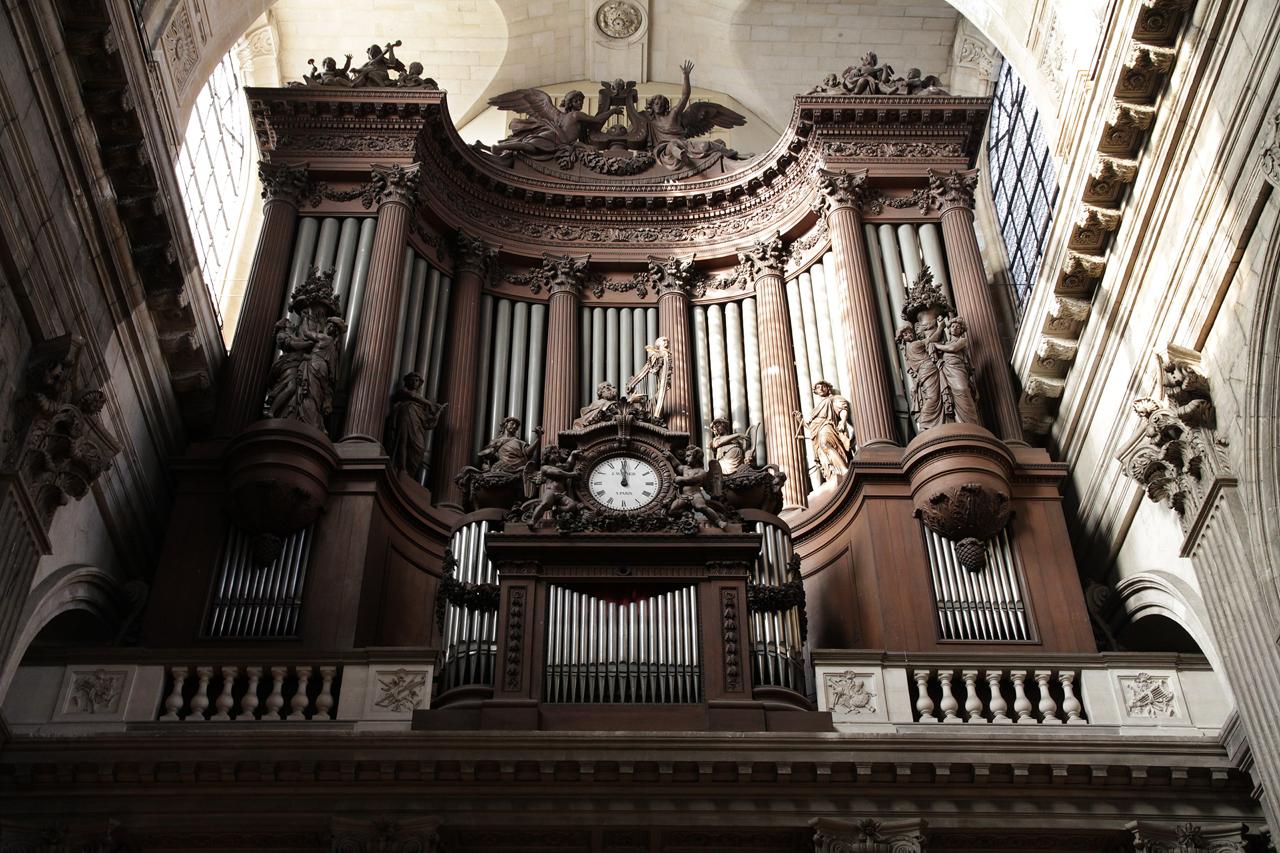
His masterpieces still stand at Saint-Sulpice, the Basilica of Saint-Denis, La Madeleine, Sainte-Clotilde, Sainte-Trinité and Notre-Dame itself. The 1862 organ at Saint-Sulpice, with its 100 stops across five manuals, was in its day one of only three instruments of that scale in Europe, alongside Ulm Cathedral and Liverpool Cathedral. The German Bach specialist Adolphe Hesse, hearing it soon after completion, called it simply “the masterpiece of modern organ building.” At Notre-Dame, Cavaillé-Coll’s 1868 organ — eventually expanded to nearly 8,000 pipes and around 115 stops across five manuals — emerged only after fierce political wrangling that ended with Berlioz and Rossini signing a petition on the builder’s behalf.
What makes Paris genuinely unique is not simply the instruments, but who played them. For over a century, the city’s great organ lofts were occupied not by anonymous functionaries but by some of the most important composers in Western music, writing works specifically for the instrument beneath their hands.
At Sainte-Clotilde, César Franck was appointed titular organist in 1859, the same year Cavaillé-Coll’s new instrument was inaugurated. Franck’s improvisations there drew Franz Liszt to the loft whenever he was in Paris, and the position passed afterward to Gabriel Pierné, then to the great improviser Charles Tournemire, and later to Jean Langlais — an unbroken lineage now remembered as “the Sainte-Clotilde tradition.”
At La Madeleine, the roll call is almost implausible: Camille Saint-Saëns held the post from 1857 to 1877, followed by Théodore Dubois, then Gabriel Fauré from 1896 to 1905. The Madeleine organ also has a darker historical footnote — it was played at Chopin’s funeral in 1849, where his own Marche funèbre was heard in this form for the first time.
At Sainte-Trinité, Olivier Messiaen served as titulaire from 1931 until his death in 1992, composing much of his organ repertoire directly for that instrument’s distinctive, almost soloistic stop colours. And at Saint-Eustache, the flamboyant virtuoso and composer Jean Guillou held the post from 1963 to 2015, presiding over a dramatic 1989 rebuild by the Dutch firm Van den Heuvel that gave the church one of France’s largest and most versatile modern organs.
No recent chapter in this story matters more than what happened at Notre-Dame. When fire tore through the cathedral on 15 April 2019, the Grand Organ survived structurally, but lead dust from the melted roof settled through its nearly 8,000 pipes, and heat and humidity threatened irreversible damage. Three French workshops spent years dismantling almost every component — pipes, windchests, wind trunks, the five-manual console — cleaning, decontaminating and, where necessary, rebuilding by hand.
On 7 and 8 December 2024, the cathedral reopened to the world. During the ceremony, Archbishop Laurent Ulrich called out, “Awake, oh organ, let God’s praise be heard,” and titular organists Olivier Latry, Vincent Dubois, Thierry Escaich and Thibault Fajoles answered with a shared improvisation lasting roughly ten minutes — the instrument’s first public sound in more than five years. Notre-Dame’s 2025–2026 sacred music season, its most ambitious since the restoration, now includes fifty concerts across fifty Tuesday evenings, with twelve organ recitals from the cathedral’s titulaires and visiting international soloists, alongside six newly commissioned works.
What distinguishes Paris from other historic organ centres is that almost none of this belongs only to the past. Saint-Sulpice still holds Saturday vespers at 5:30pm, where Daniel Roth — titulaire of the great Cavaillé-Coll organ — improvises freely, continuing a ritual over a century old. Notre-Dame offers free organ performances every Sunday afternoon. Saint-Eustache, under current titulaires Baptiste-Florian Marle-Ouvrard and Thomas Ospital, maintains its own recital tradition. And every year, two dates transform the whole city into an open organ loft: the Fête de la Musique on 21 June, when churches across Paris open their doors for free performances, and the Journées Européennes du Patrimoine in September, when associations such as Le Paris des Orgues run “organ marathons” through smaller, lesser-known instruments — from Saint-Germain l’Auxerrois to Notre-Dame-des-Blancs-Manteaux — that rarely receive public attention the rest of the year.
IOOF
Sitemap